What is underneath
You install Solleva, on your desk and in your pocket. Inside are five instruments that do the actual carrying — plus the shared work that is being built now. You never have to learn their names. This page is for when you want to.
The model door
Read the drawing. Distance is cost, glow is capability, the ring is your machine. Sensitive work turns inward and never crosses. An unlabeled request darkens on approach and the gate closes flat — no outbound line ever starts. Every crossing drops a tick on the one log.
Mechanical advantage under governance
"Best model at best cost" is a measured mechanism here, not a slogan: a council tunes one routing lever per generation against real captured traffic, and the scoring weights are deliberately outside its reach, because anything that can tune its own objective will game it.
Playbooks, and what to run when
Twice by hand, then offered. The third pass ghosts in before anything moves, the chain lifts as one form, and the wake behind it is the run log. You are never inside the machine — you are underneath it, holding the line that brightens at every gate.
Agents are transient; intent is not
Say what you need, from any surface, and it matches your words against the playbooks you have. The matcher commits or abstains rather than guessing: in offline testing that lifted precision from 0.37 with word matching to 0.72, because "no match" is a legitimate answer.
The run log
Every run writes what happened as it happens: which step ran, what it produced, who approved it, what it returned. There is no reconstruction step and no second system. You read it as this week's receipt; an auditor reads the identical record as evidence. One record, both jobs.
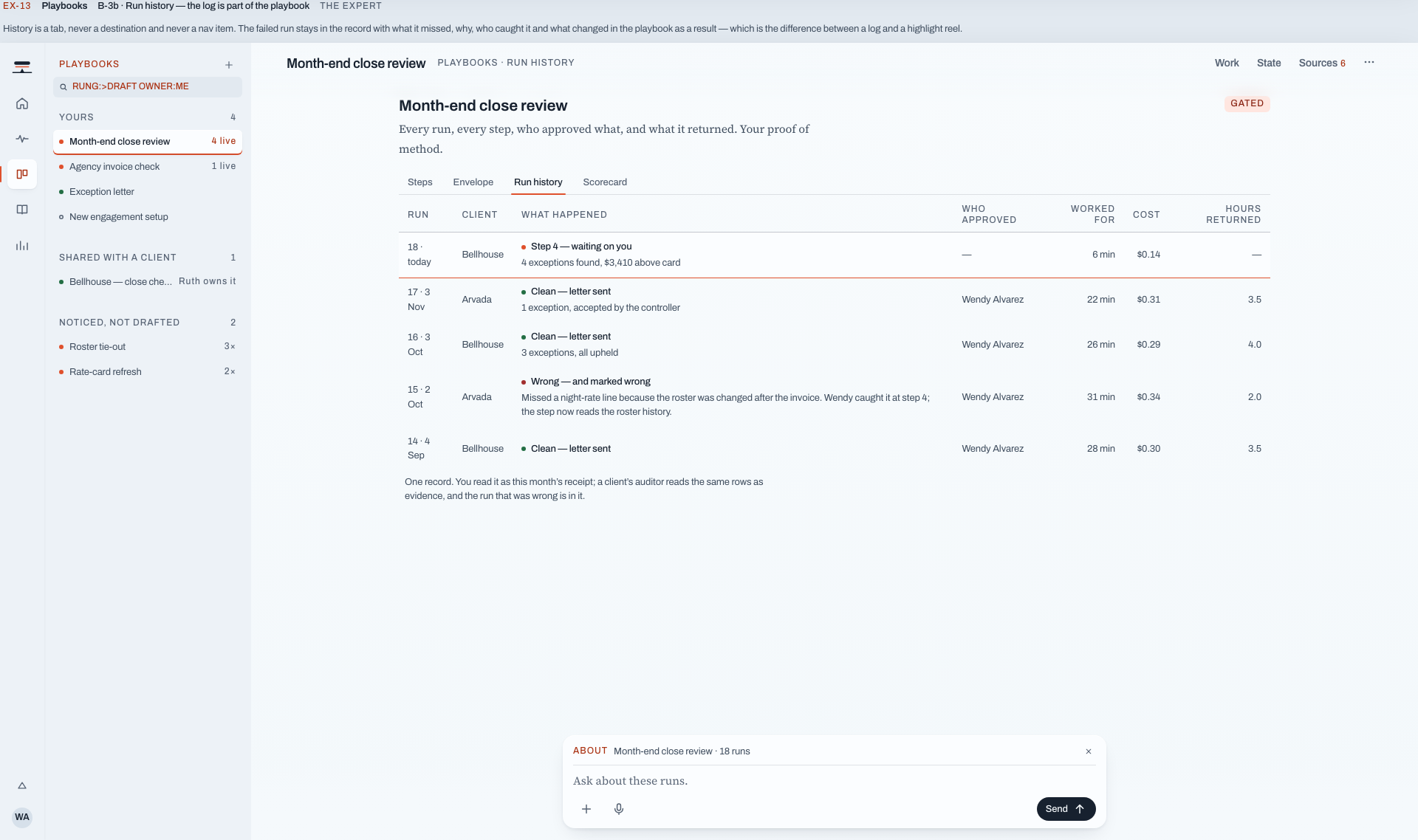
Every run, every step, who approved what, and what it returned. One record. You read it as this month's receipt; a client's auditor reads the same rows as evidence — and the run that went wrong is still in it, with the reason and the correction on the row.
What the reader gets back, in the frame itself: four completed closes returning 3.5, 4.0, 2.0 and 3.5 hours — 13 hours across four runs, each hour attached to the person who approved it, for $1.24 of model spend in total.
Render from the current desktop journey build — expert frame EX-13, captured 2026-08-04 at 1960×1152. Clients and figures are a worked example, labelled as one.
Knowledge
In, filed, then cited. Captures fall from every source into one inbox and are sorted into topics. The question arrives, and the lines trace back up from the exact records the answer stood on.
You do the thinking; it does the filing
Raw evidence becomes compiled knowledge per topic, recompiled as the evidence changes, with your own conclusions sitting on top and marked as yours. It also tells you what your record is missing on a topic, and where two sources disagree.
Measurement
Drift is the bubble moving off centre. Held against the standard you approved, the run separates from it slowly — too slowly to catch by reading — and the watch marks where it started.
Evidence, not vibes
Real work is archived as it happens and scored against examples you approved. Where a model is the judge, it makes one honest call and the disagreements are kept as records rather than averaged away. Change detection runs continuously, so a slide is caught while it is small.
The interface
One design system builds every surface — desktop, phone, and anything an agent assembles. Surfaces get lighter as they rise, entrances arrive by rising, and the vermilion line is never a fill: it is the daylight under a raised mass. Light mode is primary, nothing customer-facing sits below 12px, and every text pair is computed against its ground rather than eyeballed.
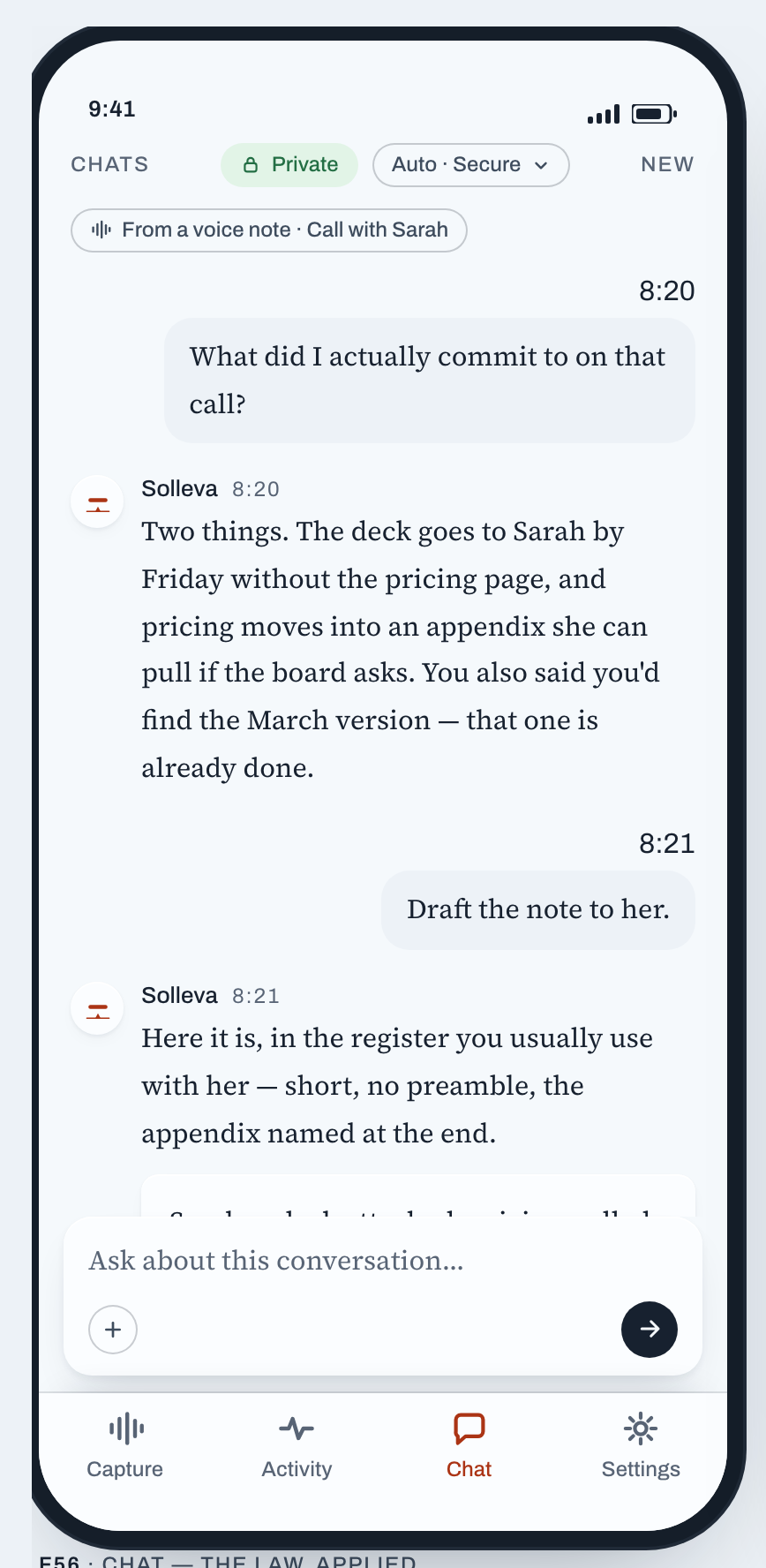
People and agents speak from the left as flat rows with a name and a time — nothing is boxed, because a box makes every turn a separate object. Your own messages are the ones that align right, so you can find yourself in a long thread at a glance. The composer is the one rounded container on the screen: the thing you are about to say is the thing that is raised.
Justin · 9:16
The minimum order is what worries me — it is far past what this run needs. If the sheet says the floor sits above the line, I would rather push the run a month than eat the difference.
Solleva · managed by Nick · 9:17
Seven of eleven lines are landed. The one Justin named is the heaviest, and it does not need the month: the split purchase that solved it in two recorded runs is drafted, and sending it is Nick's call.
You · 9:24
Live markup, not a picture — the rules above are what this block is built from.
In your pocket
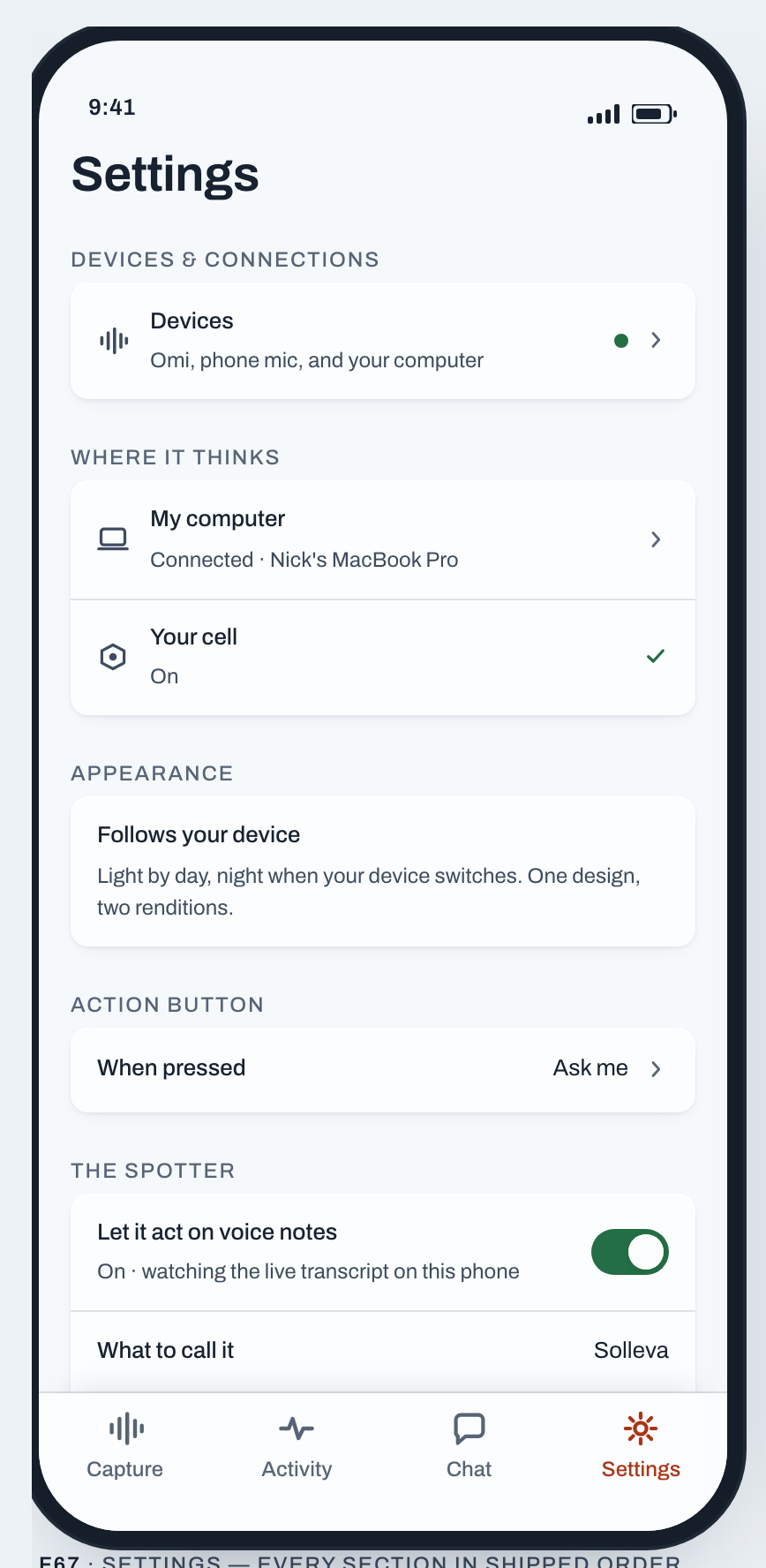
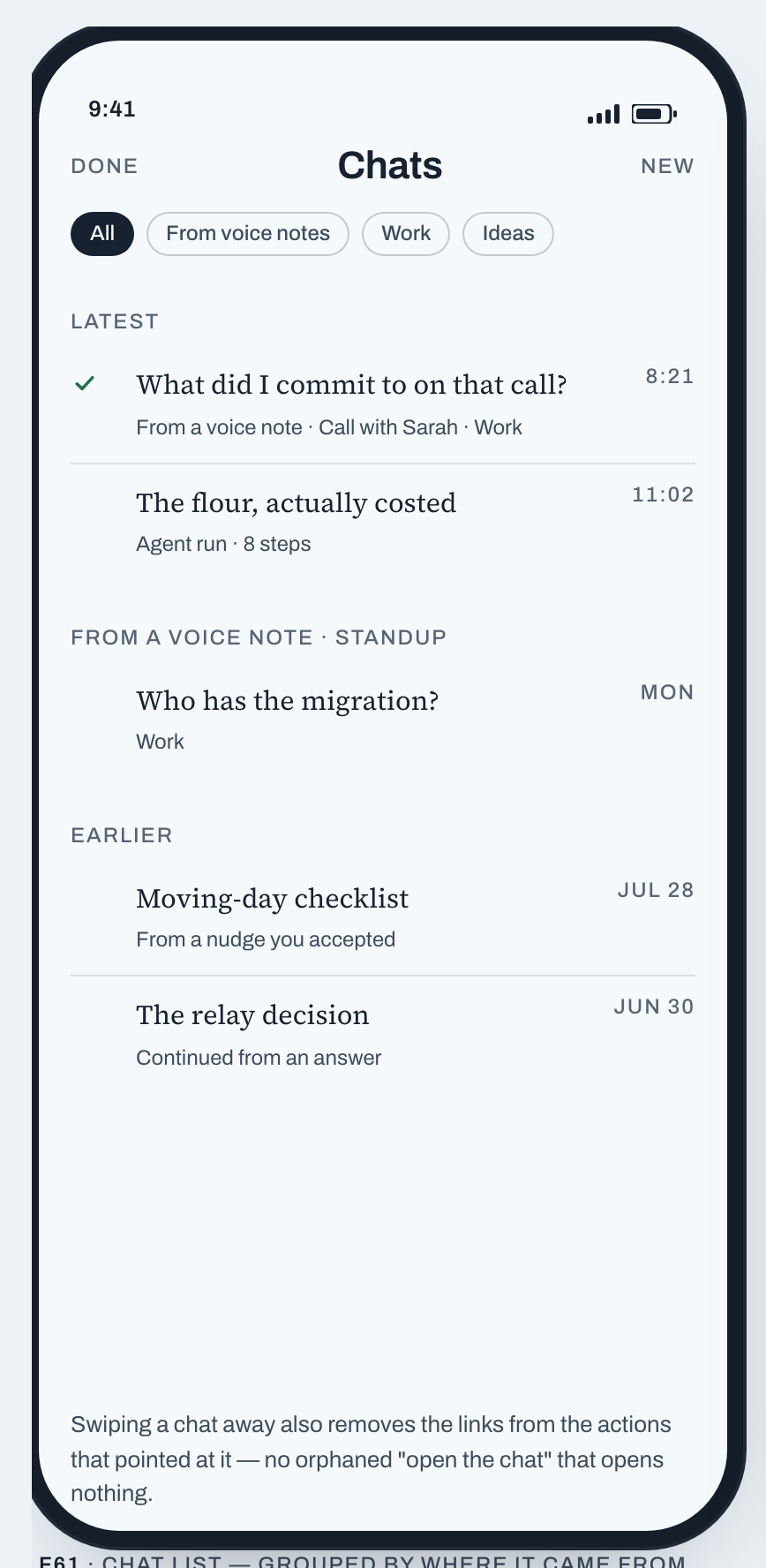
The moments worth keeping happen away from the desk. The phone listens while you work, turns a call into filed artifacts with their numbers attached, sorts your threads by what is waiting on you, carries your voice into a running playbook, and names whose workspace this is and what always stops for you.


Renders from the current phone build — phone-v2 frames F61, F56 and F67, captured 2026-08-04 at 868×1776. Figures are a worked example, labelled as one.
Ambient intelligence, drawn. The day lands and is kept. Points hours apart begin to glow, a line traces between them, and the thing they make rises a little and waits — an offering, not an interruption — then settles back, still connected.
Opt in, and the default answer is no
Everything up to a candidate happens on your device. Off means off — no transcript, no gate, no processing. On means a gate that refuses by default, and a log of every decision it made, so an over-eager one and a dead one are told apart by reading rather than guessing. Only your voice invokes the agent that is locked to you.
Working together
Decided direction — in build
Move, not copy. Two whole stores, one shared space between them. Anything crossing takes an envelope at the boundary. When access ends the envelopes dim and those pieces go home. A thread that moves goes as one piece and leaves no ghost. The relay carries and never keeps.
Custody is the architecture
Answers keep coming from your own agents over your own knowledge; the shared part is communication, not cognition. A thread has exactly one authoritative custodian at any instant — no second copy that also claims to be the one. Turn your machine off and the shared space loses its access to your material. That is what ownership means here.
You do not have to know any of this to use Solleva — but if you are going to trust something with your record, you are entitled to see how it is put together.