About
It was not designed in a lab and then taken looking for a problem. It came out of building and running software inside real operating businesses, where a missed step costs money and someone eventually asks to see the record.
The roots
Magnitude Labs builds software that businesses actually run on. That work sets the bar three ways, and every one of them is now a rule inside Solleva.
The record has to be readable by someone outside. An operator's weekly receipt and an auditor's evidence trail have to be the same rows, or one of them is a reconstruction — and reconstructions are where trust goes to die.
The sensitive work has to stay put. Not as a policy someone remembers, but as a route the system takes: confidential material is answered on machines the business controls, and an unlabelled request is treated as the strictest case rather than the most convenient one.
The method has to survive the person who wrote it. A business that depends on one person's memory has a single point of failure with a family and a calendar. Writing the method down, and having it run the same way every time, is what turns hard-won practice into something the business owns.
The whole company in one drawing. Work done twice by hand, then lifted as one form and run above the line — with the log trailing behind it and the person still holding the string.
Solleva is a Magnitude Labs Inc. company.
The mission
Building digital infrastructure for human agency.
Agency through creation. What has driven three centuries of progress is not software: it is people with an idea who are willing to take a risk, and who need to know where to start. Most of them stop at exactly that point — not from lack of will, but because the next move is unknown and the cost of guessing wrong is high.
So the product's job is narrow and stubborn. When you do not know how to do the next thing, it puts the pieces underneath it — what the thing is made of, where the parts come from, what stands in the way, what to do first — and turns what works into a method you can run again or hand to someone you hire. And it must never be frightening to try.
The other half of that sentence matters as much: expertise compounds with the person — and the business — that earned it, instead of leaking into someone else's model.
We see when you are doing things repetitively, and we learn how to lift that weight with you and give you leverage.
This is the one page here that carries no customer-return number, and that is deliberate: there is no shipped engagement to cite yet, and inventing one would break the standard this section is describing. So it states a count of a real document — six gates — and two concrete outcomes instead. Every number elsewhere on this site is read off a render and labelled with the frame it came from.
The history
Each attempt was true and none of them was the sentence. They are listed here as history — the products are gone, the lessons are in the software.
2024 · Forge
Three words, and the oldest surviving promise in the company. Everything since has been a different attempt to say how.
2025 · Conductor
The lesson that stuck: the interesting object is not the model, it is how the work flows — and a human holds the gates.
2026 · Lore
You do the thinking; it does the filing. Capture everything, and answer from your own record with the sources attached.
2026 · FoundryX
The phone chapter — ambient capture that acts. The line is retired: Solleva does not promise you carry nothing. It makes what you carry liftable.
Now · Solleva
The forge metaphor is retired with the names it produced. Heat, force and danger were never the register of a product whose whole point is that trying should not be scary. The promise never changed; the name finally says it.
There is one more thing worth saying in the past tense. For thirty years, software made its users into its operators — you learned its screens, its order of operations, its vocabulary, and you called that a skill. That is what we set out to end. Not by promising magic, but by making the software learn your steps instead.
Which means the honest comparison is never Solleva against enterprise software from 1995. It is Solleva against the three things you would otherwise do: paste the work into a chatbot, hire a consultant who leaves a deck behind, or hire a junior and hope the knowledge stays. A chatbot gives everyone the same answer. A deck is not a system. And knowledge that lives in one person walks out the door with them.
The dots
The moving dots are not decoration. They are the argument rendered as physics, and they run through the site, the book and every diagram we draw. Four beats: scatter — life as it arrives; gather — it notices; form — a pattern is found; lift — the formed thing rises and runs, and the weight leaves you. The rule that keeps it honest: the system never adds dots. It arranges what is already yours.
Scatter and gather. The day lands and is kept; then points far apart begin to glow and a line traces between them.
Form. Captures fall into one place, sort themselves into topics, and the answer traces back to the exact records it stood on.
One real thing you carry — and dots are conserved, never invented.
You. One per person, so the eye always knows where the human is.
The gap under a raised mass. The accent colour is never a fill — it is the light in the gap.
The trail a running playbook leaves: the run log, part of the playbook.
The name
Solleva is Italian for "it lifts" — third person, present tense, the thing happening right now. It comes from Latin sublevāre, which carries three senses at once: to lift from underneath, to support and encourage, and to lighten. That is the entire product in one verb, and the direction matters: the lift comes from below. You keep your grip on the work.
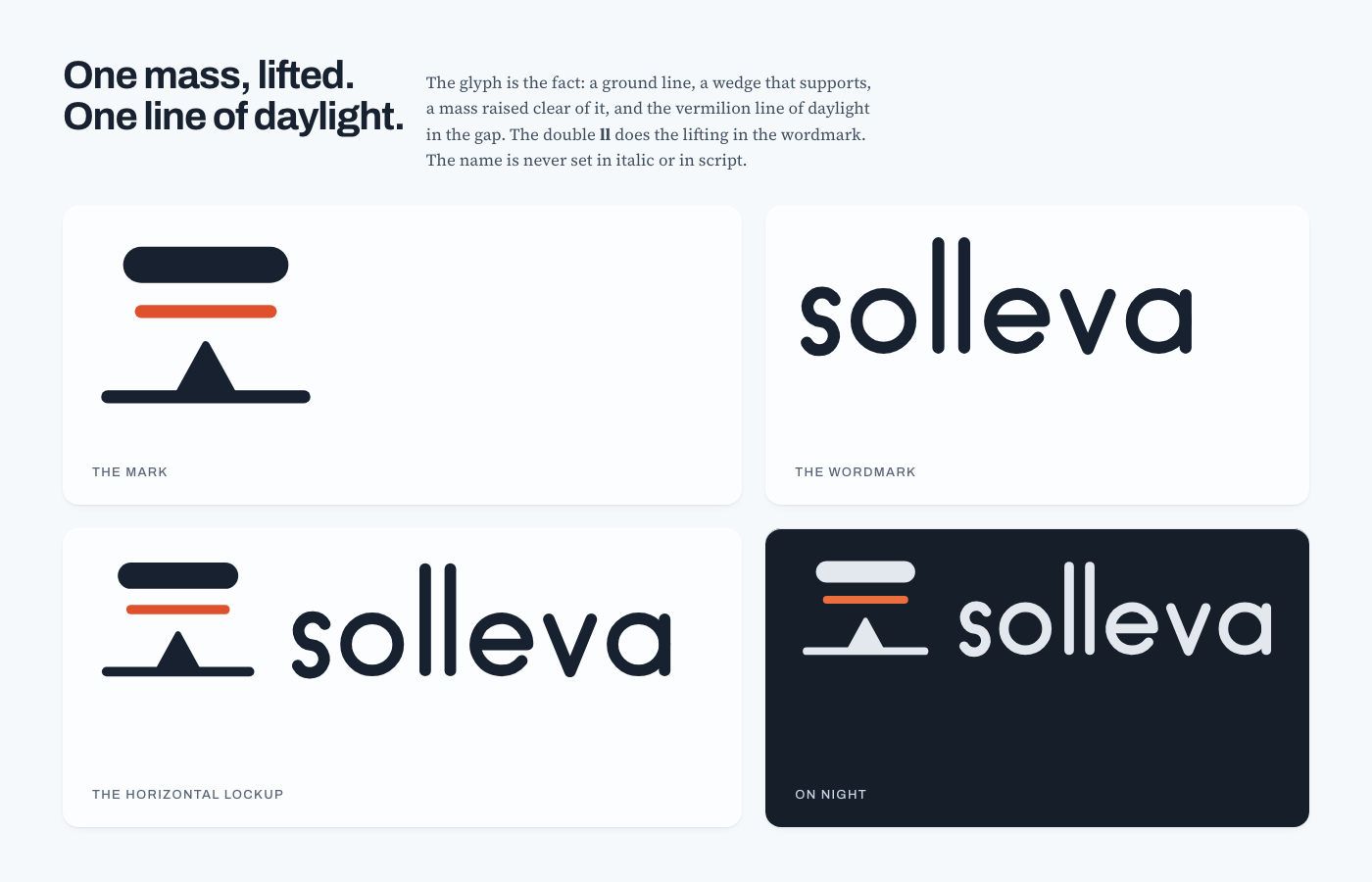
The mark draws the same fact — a ground line, a supporting wedge, a mass raised clear of it, and the vermilion line of daylight in the gap. The double ll is set to work as the two lifting verticals, so the mark teaches the spelling. The name is never set in italic or in script.
Every mark draws one fact: this was resting; now it is raised, and something holds it.
Plate built 2026-08-04 from the shipped vector assets in the logo set — the mark, the wordmark and the horizontal lockup in both renditions.
That is what the mission is for. Lower the cost of the next step far enough and more people take it — which is the only version of this technology worth building.