It lands
01
Everything you carry arrives in one place.
A call you had in the car, a clip you saved at midnight, an email thread, a document someone sent, a number you typed. Solleva files it against the topics you already have and tells you what it could not place, instead of quietly dropping it.
In, then filed. Sources at the top, one inbox in the middle, topics along the ground. Nothing is invented — the dots are only arranged.
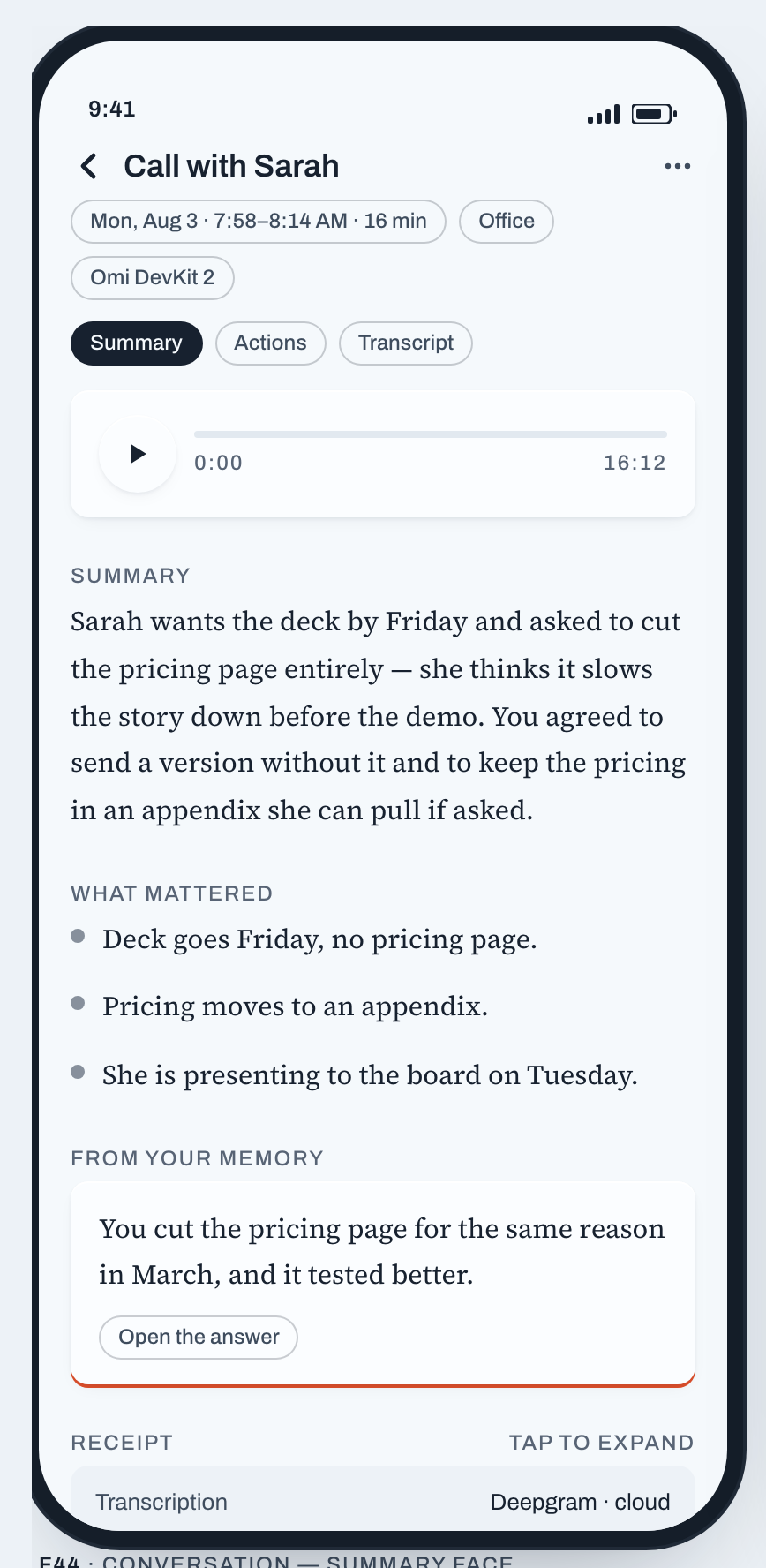
A sixteen-minute call, filed. A summary, the three things that mattered, and the record that you decided this once before — with the receipt saying what ran where.
It notices
02
We see when you are doing the same thing over and over.
Nobody operates this part. The stream of your own work is watched for a shape that keeps coming back — the same five moves on the reorder, the same three checks before a bid goes out. When one is strong enough, Solleva offers it back to you as a candidate. Nothing runs off the back of that offer until you say so.
Found across hours. Points far apart in the day begin to glow, a line traces between them, and the small thing they make rises a little and waits. The rise is slight on purpose — it is an offer, not an interruption.
It becomes a playbook
03
Your steps, your checks, your judgment calls — written down and editable.
A playbook is not a template with your logo on it. It is the order you actually work in, the numbers you always look at, and the exact moments you want to be asked. You read it in plain language, change what is wrong, and mark where the run must stop. What you correct stays corrected.
Twice by hand, then offered. The line begins to trace ahead of you on the second pass. On the third the whole chain lifts as one form and runs above the ground — with the wake behind it, and you underneath holding the line.
It runs
04
It stops exactly where you told it to stop.
The run happens inside the conversation, not in a console you have to remember to check. The card names the step it is on and the lines that need a person, and says whose call each one is. Say a new rule out loud and it is written onto this run and every run after it. The log is written as it goes: which step ran, what it produced, who approved it, what it returned.
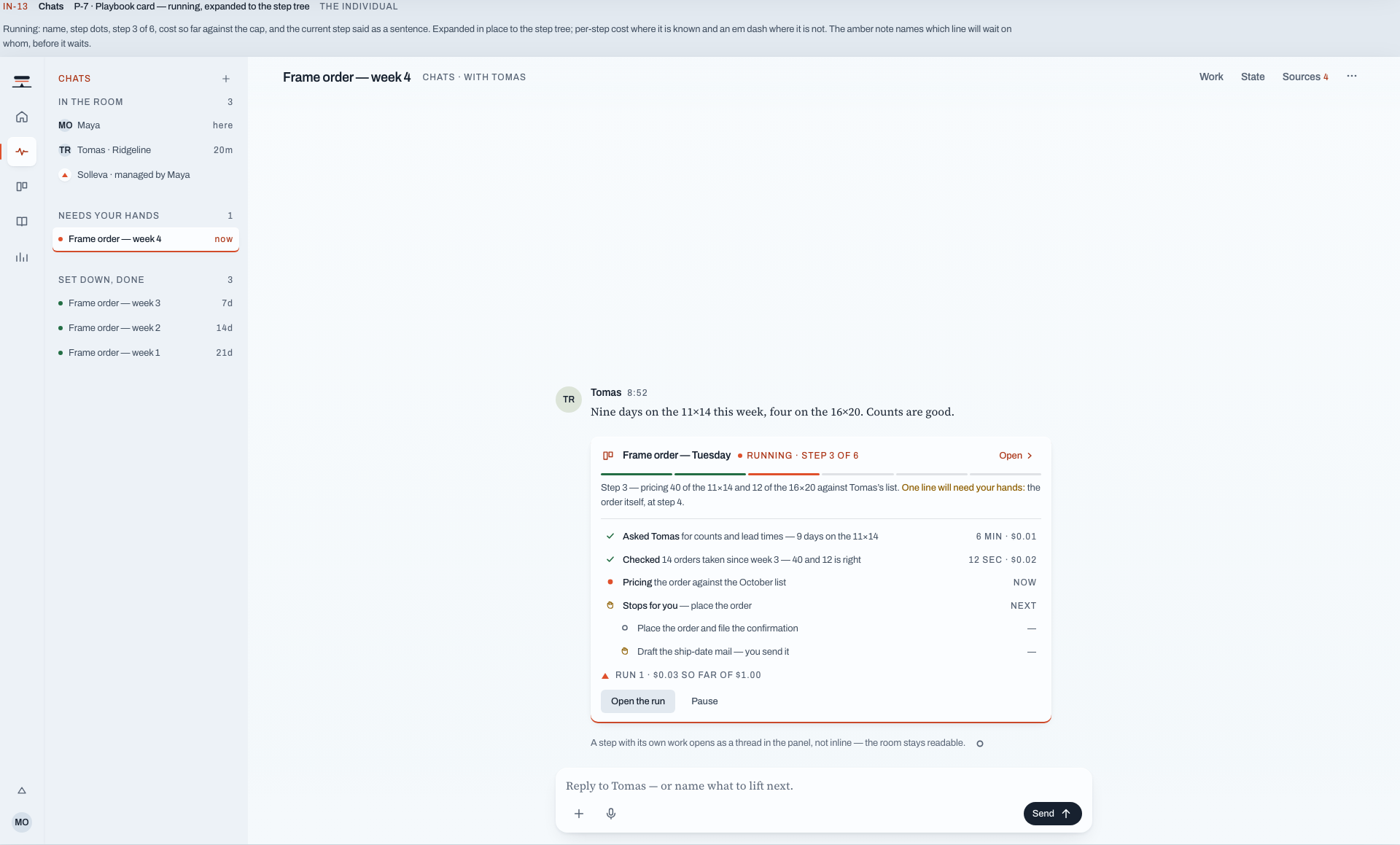
Six steps, running at step three, and the next one stops for you. The card is the run and the log at the same time: each finished step says what it did, how long it took and what it cost, and the step that needs a person says so before it gets there.
What the reader gets back, in the frame itself: two of the six steps are done in 6 minutes and 12 seconds of machine time for 3 cents against a $1.00 ceiling — and none of those minutes were yours.
Render from the current desktop journey build — individual frame IN-13, captured 2026-08-04 at 1960×1152. Figures are a worked example, labelled as one.
It is routed
05
Every model call inside the run passes one door.
Each request carries how sensitive it is and what kind of call it is — chat, speech in, speech out, retrieval, ranking. The door sends it to the cheapest target that satisfies both. Confidential work is answered on your own machine; a request with no label is treated as the strictest tier there is. Money is held before the call and settled after, against a ceiling you set, so a loop that goes wrong stops at a number instead of at an invoice.
Refusal is drawn, not asserted. Watch the unlabeled request: it darkens as it approaches, the gate closes flat, and it comes back. No outbound line ever starts.
It is measured
06
Held to the standard you approved, and told when it stops holding.
A test says a moment was fine. Measurement says whether the thing is still fine this week. Solleva scores its own runs against examples you signed off on, keeps the disagreements as records, and watches for the slow separation that no one catches by reading. When something is tried, the record says what was tried, what won, and what changed.
Caught while it is small. The measured run separates from the reference; the bubble goes off centre; the watch marks the moment it started.
It becomes leverage
07
The second run costs you one approval. The tenth you can hand to someone else.
This is the whole point of writing it down. A method that runs the same way every time is something you can delegate — to the software, to a new hire, or to a partner in a shared space where your material stays wrapped and yours. What you learned the hard way stops being a thing you personally have to be present for.
Handed over without being given away. Each store stays whole. What crosses is wrapped at the boundary; when access ends it goes home; a thread that moves moves as one piece.
Shared spaces — decided direction, in build